



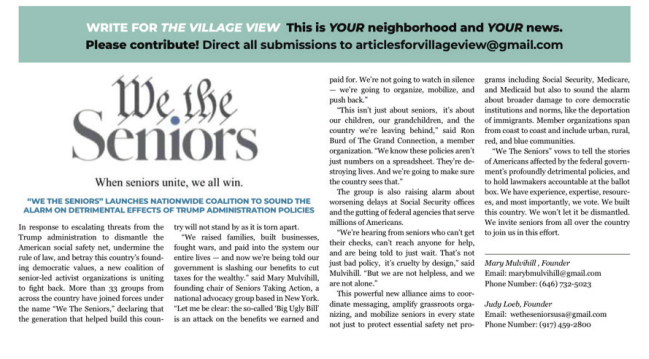
In August Judy Loeb and Mary Mulvihill were interviewed by the Sag Harbor Express in Long Island about We the Seniors
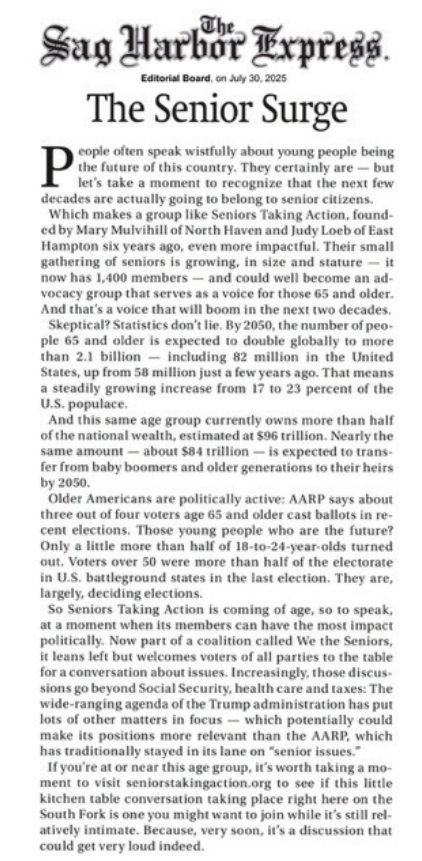
“We are dealing with issues that all communities face, whether you are a Republican or Democrat. We care about Social Security, we care about health care, and things like that.”
“I think there are a lot of disaffected independents and Republicans who are against the Trump agenda,” added Loeb.
She said people have also expressed concerns about the repercussions that the so-called “Big, Beautiful Bill,” the domestic package which the president signed into law earlier this month, will have on them as well as the administration’s hard-line approach toward immigrants. “People are very upset with the way they are disappearing people from off the streets and putting them in what are virtually
concentration camps,” she said.
“In the course of doing this, we realized seniors really do have a voice,” said Mulvihill. “And they need to have a louder voice,
because they are the biggest group of voters in the country, and they know the issues.
“We thought, why don’t we try to organize all the seniors in the country and get them involved and organized to speak out as a group on particular issues,” she continued.
Both women are at a loss to describe how their local group began to grow so quickly. One reason, they agree, is they have held a weekly series that has hosted a number of prominent speakers, including Senator Cory Booker of New Jersey and former U.S. Representative Liz Cheney. Others include Robert Hubble, who has written about the group in his “Today’s Edition” newsletter on Substack, which has more than 100,000 followers.
We the Seniors does not have website yet, but that hasn’t stopped people from writing to its email, wetheseniorsusa@gmail.com. “We have been inundated,” said Mulvihill. “Judy and I don’t have any free time.”
Mulvihill and Loeb say We the Seniors will be fundamentally different from AARP, the senior organization that lobbies for Social Security, Medicare and other issues important to seniors, but which does not take the kind of political positions they envision We The Seniors doing.
“If I had my druthers, we’d be kind of the go-to group for the media, journalists, podcasts, whatever,” said Loeb. “When they think, ‘What are seniors thinking?’ they would contact We the Seniors.” Mulvihill said that if seniors, as the largest voting bloc in the country, were organized, elected offi cials would have no choice but to listen to them.
“We can have an impact and we can help save our democracy,” she said. “Our vote is a huge vote. We don’t have to remind seniors to go to the polls, we know they will go to the polls.
For more information, email wetheseniorsusa@gmail.com or visit the website of Seniors Taking Action, seniorstakingaction.org. connect with us,” she said.